

When the Independent National Electoral Commission (INEC) announced the date for the Anambra State governorship election, many observers feared the worst. The state, often regarded as the heartbeat of political activity in the South-East, has a long history of tense electoral contests, complicated further by separatist agitations and criminal incursions in parts of the state.
However, against all odds, the election came and went without the kind of chaos many predicted. Voters trooped out to cast their ballots peacefully. Collation proceeded without major incident. By the time results began trickling in, one thing had become clear: Anambra had experienced one of its most peaceful elections in recent memory.
Behind that success story stands one man — Deputy Inspector-General of Police (DIG) Benjamin Okolo — the officer who, under the direction of the Inspector-General of Police (IGP) Kayode Egbetokun, led the enforcement of a robust security architecture that neutralised potential flashpoints and ensured a seamless electoral process across all 21 local government areas of the state.
In previous elections, Anambra had often been in the news for the wrong reasons, ballot snatching, sporadic violence, intimidation, and logistical disruptions. In some cycles, elections were even postponed or rescheduled in certain local government areas because of security concerns.
This time, the story was remarkably different. The polls opened as scheduled, materials and personnel arrived early, and security agents maintained a non-intrusive but visible presence at polling units. The streets of Awka, Onitsha, Nnewi, and Ihiala — once labelled as “red zones” — were calm, orderly, and secure.
This outcome, according to DIG Okolo, was no accident. It was the product of “deliberate strategy, early preparation, and the clear directives of the Inspector-General of Police,” who he said provided the leadership framework for the operation.
“The arrangements put in place under the guidance of the IGP have been excellent,” Okolo said during an interview with THISDAY in Awka. “His directives ensured that all agencies performed effectively, and this has contributed immensely to the peace we are witnessing.”
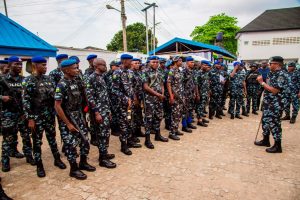
DIG Okolo, who heads the Force Intelligence Department, was specifically assigned by IGP Egbetokun to coordinate election security in Anambra. Under his watch, the police deployed thousands of officers across all local government areas, supported by specialised units from the Counter Terrorism Squad, Mobile Police (PMF), Explosives Ordnance Disposal (EOD) Unit, Marine Police, and the Airwing Department.
Security operations were structured in three phases — the pre-election phase, voting day, and post-election collation and result management.
“Security coverage was organised in phases, from the movement of election materials and personnel to polling units, through voting, and finally to collation centres,” Okolo explained. “We anticipated challenges, particularly during collation, so we made sure our deployments covered the chain from polling units to ward and local government centres, up to the INEC headquarters.”
In addition to boots on the ground, the police deployed air surveillance and drones across sensitive areas. “The essence of a show of force, whether through air or ground presence, is to demonstrate authority and deter mischief. It contributed positively to the success of the election,” he noted.
At polling units, police presence was reassuring but disciplined. Voters described officers as “polite but firm,” ensuring order without intimidation. Reports from election observers corroborated this, stating that the police and sister agencies maintained professionalism throughout the exercise.
Anambra’s security map before the election showed numerous potential flashpoints — Onitsha North and South, Ogbaru, Idemili North and South, Aguata, Ihiala, and parts of Nnewi. These areas had recorded various forms of insecurity in the months preceding the election, ranging from cult clashes to separatist activities.
To neutralise these threats, DIG Okolo ordered pre-election clearance operations in conjunction with the military and the Department of State Services (DSS). “In Ihiala, which used to be a major concern, we carried out targeted clearance operations before the election,” he said. “That contributed significantly to the peace we observed on election day.”
The results were evident. Areas like Ogbaru, Obosi, and Nkpor — previously notorious for election-day violence — recorded no major incidents. Patrol teams and checkpoints were strategically placed at all entry and exit points, while communication lines remained open between field commanders and the central control room in Awka.
DIG Okolo’s reputation as an “operations and intelligence hybrid” came to the fore during this assignment. As a career officer known for his grasp of criminal intelligence and threat assessment, Okolo leaned heavily on data-driven decision-making.
“Our deployments were intelligence-led,” a senior officer in the operation revealed. “We used real-time feeds from surveillance drones and patrol reports to respond instantly to potential disturbances. Nothing was left to chance.”
The Force Intelligence Bureau (FIB) and Technical Intelligence Unit (TIU) also worked closely with the Anambra State Police Command to track movements and monitor communication among suspected mischief-makers. This proactive approach ensured that no major breach occurred before, during, or after voting.
DIG Okolo also credited the groundwork of CP Ikioye Orutugu, the Anambra State Commissioner of Police, for the peaceful atmosphere. Weeks before the election, CP Orutugu held series of community engagements, stakeholders’ meetings, and media briefings that helped to demystify police operations and build public confidence.
“Stakeholder meetings, peace accords, and pre-election sensitisation were crucial,” Okolo explained. “We interacted with political actors, traditional leaders, and youth groups to ensure collective responsibility for peace.”
In many communities, local vigilantes worked in coordination with the police under strict supervision. This synergy — part of IGP Egbetokun’s “Community Safety Framework” — allowed for real-time intelligence sharing and quicker response to incidents.
Throughout the election period, the conduct of security personnel came under scrutiny from election monitors and civil society groups. DIG Okolo, however, reported zero cases of misconduct.
“There have been no reports of unprofessional conduct by any police, military, or other officer involved in the assignment,” he stated confidently. “Our personnel behaved professionally and exemplarily.”
Observers from the Transition Monitoring Group (TMG) and YIAGA Africa later confirmed that officers displayed commendable restraint, particularly in conflict-prone areas, where potential confrontations were de-escalated through dialogue rather than force.
While the Anambra election is widely celebrated as peaceful, DIG Okolo acknowledged that certain logistical and communication challenges remain areas for improvement. “We had minor infractions like breaches of the no-movement regulation, but nothing significant enough to disrupt the process,” he said.
He also emphasised that maintaining security beyond the election period is critical. “Security does not end with voting. Our architecture will remain until the IGP directs otherwise,” he affirmed.
Okolo’s perspective underscores a broader institutional philosophy: elections are not isolated events but part of a continuous process of building public trust.
As the officer in charge of the Force Intelligence Department, DIG Okolo represents the operational face of IGP Kayode Egbetokun’s vision of an intelligence-led, citizen-focused policing system.
His performance in Anambra reflects the IGP’s broader mandate to professionalise election security and restore public confidence in democratic institutions.
“DIG Okolo’s leadership embodies what the IGP has been preaching — proactive intelligence, inter-agency cooperation, and community partnership,” noted a senior police source in Abuja. “He’s an enforcer of the IGP’s vision for credible elections.”
Indeed, by combining intelligence with operational discipline, and firmness with empathy, Okolo managed to deliver a result many doubted was possible — a violence-free, credible election in one of Nigeria’s most politically charged states.
The success of the Anambra governorship election provides a useful model for future polls across the federation. It shows that early planning, strategic intelligence, inter-agency collaboration, and respect for citizens’ rights are the bedrock of peaceful elections.
For DIG Benjamin Okolo, it also marks another career milestone — a testament to his calm but firm leadership style, his commitment to duty, and his ability to translate the IGP’s directives into effective ground operations.
As Anambra residents celebrate a violence-free election, one name stands tall among those who made it possible: DIG Benjamin Okolo — the enforcer of the IGP’s mandate and the architect of peace.
DIG Okolo: The Enforcer of IGP’s Mandate Who Delivered a Violence-Free Election in Anambra
- Advertisement -
- Advertisement -
This is another opportunity to own a faster-loading website to expand your business and take it digitally online. Meet the best website designer/master coder for any kind of website. Contact them now it is affordable Chat now: 09077260922

Latest news
- Advertisement -
This is another opportunity to own a faster-loading website to expand your business and take it digitally online. Meet the best website designer/master coder for any kind of website. Contact them now it is affordable Chat now: 09077260922
- Advertisement -
