


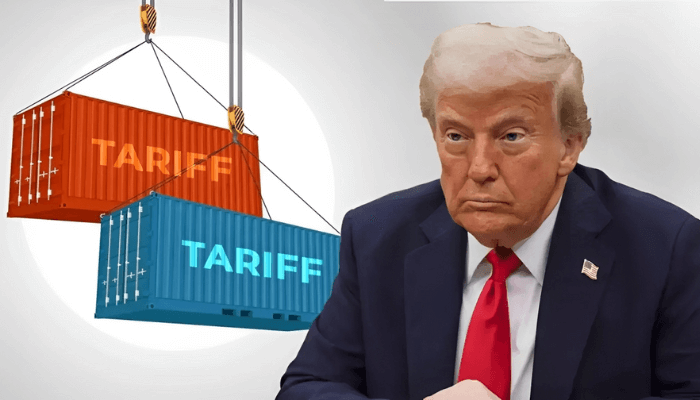
If US President Donald Trump follows through on his recent threat to impose a 10% tariff on nations who are part of the BRICS alliance, Nigeria’s already precarious economy may be put under further stress.
According to reports, Trump, who has stepped up his trade rhetoric in the run-up to the US elections, threatened on Sunday via his Truth Social platform that any country that supports the “anti-American” policies of the BRICS would be subject to an additional import tax. “This policy will not have any exceptions,” he said.
Nigeria has taken part in meetings and projects under the emerging economies bloc since officially joining the BRICS in January 2025.
At the request of Brazilian President Luiz Inácio Lula da Silva, President Bola Tinubu came in Rio de Janeiro on Saturday for the 17th BRICS Summit, signifying Nigeria’s ongoing participation as a partner country in the enlarged BRICS framework.
Originally composed of Brazil, Russia, India, China, and South Africa, the group was expanded in 2024 to include six more nations: Egypt, Ethiopia, Iran, Indonesia, Saudi Arabia, and the United Arab Emirates.
Despite not yet having full membership status, Nigeria regularly participates in high-level discussions, policy formulation, and summit announcements.
Read Also: 2023: Ajadi Tells Nigerians to Reject Politicians Who Failed to Deliver
The BRICS countries collectively denounced “indiscriminate” import taxes on Sunday, cautioning that they might cause economic instability worldwide. Tensions with Washington have escalated as a result of the coalition’s criticism of recent Israeli-US attacks on Iran.
Nigeria, the biggest economy in Africa, is still largely reliant on crude oil, with more than 90% of its exports to the US being petroleum.
Even though Nigeria only makes up a minor portion of US commerce, any further tariffs, especially on non-oil exports, might hinder diversification efforts and stall economic growth.
Rising inflation, currency volatility, and the effects of significant reforms, such as the elimination of fuel subsidies and the implementation of a floating exchange rate, have plagued Nigeria’s economy since 2023.
According to the Central Bank of Nigeria (CBN), headline inflation increased from 18.85% in 2022 to 34.2% in mid-2024 before decreasing to 27.5% by mid-2025.
Even with the modest respite, consumer prices are still high, and the jobless rate still clouds recovery prospects. In an effort to control inflation, the CBN’s Monetary Policy Committee has maintained interest rates in previous sessions.
Concerns about growing poverty and inequality have been raised by the GDP’s average growth of just 2.3% over the past ten years, which is less than the rate of population growth.


