


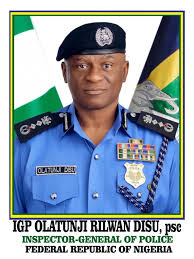
The Inspector-General of Police, Tunji Disu, has inaugurated an eight-member committee headed by Olu Ogunsakin, a professor , to oversee the implementation of State police.
Disu, has also reeled out his mission and vision for the Nigeria Police to provide effective policing for the country.
He said under his leadership as IGP, professionalism, accountability, and transparency would not be a slogans, but standards.
The IGP, in his maiden meeting with senior strategic senior officers in the Force,in Abuja, also announced plans to strengthen internal oversight, directing that the Public Complaint Unit and X-Squad be empowered to operate independently.
The IGP, while noting that,” leadership is not about position but responsibility,”said that professionalism and accountability must guide conduct and operations across commands nationwide.
He also said that authority is strongest when exercised with restraint and that respect for human rights must remain fundamental, adding that every Nigerian should be treated with dignity, fairness, and justice, regardless of status or background.
Welcoming the senior officers to the meeting, which he described as the beginning of a new administrative phåse and the opening of a defining chapter in the life of the Nigeria police, said the police must remain committed to its core mandate of protecting lives and property, while upholding the rule of law, noting that public trust is essential to effective policing.
He warned that misconduct, including abuse of power, corruption, extortion, and unlawful detention, would not be tolerated just as he charged senior officers to lead by example and uphold the highest ethical standards.
He reiterated that no officer is above the law and that disciplinary actions, including dismissal and prosecution, would be applied where necessary.
The IGP, while noting that respect for human rights is fundamental to professional policing, said that authority must be exercised with restraint, fairness, and sound judgment to maintain legitimacy.
In capacity building, the IGP, said that recruitment processes would be reviewed to ensure that only qualified and competent individuals are enlisted into the force just as he said that training programmes, would be modernised to reflect current security realities and global best practices.
Disu, who announced that community policing would be prioritised, urged state Commissioners of Police to deepen engagement with local communities, traditional institutions and civil society groups, saying that collaboration with the public was critical to effective security management.
He further stated that the force would adopt intelligence-led and technology-driven policing methods, with increased investment in digital forensics, surveillance, and data analytics to tackle evolving security threats.
On the upcoming 2027 General elections, the IGP, said that the police would remain neutral and professional, and ensure the protection of voters, electoral officials, and critical infrastructure. He warned that any officer found engaging in partisan activities or violating electoral laws would face strict disciplinary measures.
He also pledged to prioritise the welfare of officers, including improvements in housing, remuneration, healthcare and overall well-being, noting that better welfare would enhance morale and performance.
Meanwhile, the eight-member committee are made up of senior officers:Olu Ogunsakin (DG National Institute for Police Studies, Jabi, Abuja, as the Chairman; CP Bode Ojajuni, INTERPOL, as the secretary; DCP Okebechi Agora, DCP Suleyman Gulma, ACP Ikechukwu Okafor, CSP Tolulope Ipinmisho and CP Emmanuel Ojukwu (rtd), Provost Police Public Relations School as members.
He charged them to be professional innovative and to live upto the responsibility assigned to them .
The IGP, while speaking at the event, described the task before the committee as significant and timely, stressing that it responds to the growing demand for strengthened internal security and community-responsive policing.
The IGP noted that Nigeria continues to face evolving security challenges that require innovative thinking, strategic collaboration and meaningful reforms to enhance operational capacity.
He explained that the committee has a critical responsibility to shape a framework through which state policing can operate.
He said, “It is my greatest privilege to formally inaugurate this committee on State Policing. The task before this committee is both significant and timely, as it speaks directly to the demand to strengthen Nigeria’s internal security and ensure that policing remains responsive to the realities of our communities.
“Your work will help shape the framework through which state policing may operate in Nigeria in a manner that strengthens, rather than fragments, our national security system.”
The IGP charged the committee members to be guided by professionalism, objectivity and a clear understanding of the complexities of policing in a diverse nation.
He outlined the committee’s key responsibilities to include; reviewing existing policing models within and outside Nigeria, assessing community security needs and risks across the country, and proposing an operational framework for the establishment and coordination of state police structures.
Other assignments include: addressing recruitment processes, training standards, resource allocation, and developing robust accountability and oversight mechanisms to ensure professionalism and public trust.
The IGP highlighted the potential benefits of decentralised policing if carefully designed and effectively implemented.


