


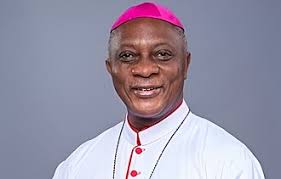
 The Catholic Archbishop of Lagos, Most Reverend Alfred Adewale Martins, has condemned the reintegration of repentant terrorists into Nigerian society and the Armed Forces, warning that such actions could endanger communities already traumatised by violent attacks.
The Catholic cleric spoke during an interaction with journalists on the occasion of the 60th World Communication Day, where he stressed that although repentance and change are possible, the safety and confidence of victims and affected communities must remain paramount.
According to him, simply declaring former terrorists “repentant” and returning them to society without adequate safeguards could have dangerous consequences.
“Whereas it is true that anybody can repent and change, it is also important to recognise the fact that these persons are coming into a society that has been hurt very badly by their actions,” he said.
The Archbishop noted that the true intentions of individuals are often difficult to determine, warning against blind trust in claims of reformation.
“To just simply say that they have repented and can go back into society can be a dangerous thing because the intent of the human heart is hidden and we can only see their faces,” he added.
He maintained that more rigorous measures would be required before such individuals could safely return to society in a manner that inspires public confidence.
“You need a lot more than just saying it in order to accept that that is the truth of the matter. Perhaps when all the violence is gone and all the terrorism is gone, they can be reintegrated in a way that will create confidence in the people,” he stated.
The Archbishop spoke just as the head of the Catholic Church, Pope Leo XIV, warned that the growing influence of artificial intelligence and digital technology poses serious threats to human identity, relationships, critical thinking, and the integrity of communication if not guided by ethical responsibility and regulation.
Reflecting on the impact of artificial intelligence on humanity and communication, the Pontiff described human faces and voices as sacred expressions of identity given by God and cautioned against their misuse in the digital age.
“Our faces and voices are unique, distinctive features of every person; they reveal a person’s own unrepeatable identity and are the defining elements of every encounter with others,” the Pope stated.
He explained that faces and voices reflect the image and love of God, stressing that human beings are not merely “predefined biochemical formulas” but individuals with unique and irreplaceable vocations.
According to the Pontiff, artificial intelligence systems are increasingly interfering not only with information systems but also with the deepest levels of human relationships by simulating wisdom, emotions, voices, and companionship.
“The challenge is not technological, but anthropological. Safeguarding faces and voices ultimately means safeguarding ourselves,” he said.
The Pope also expressed concern that algorithms designed to maximise engagement on social media platforms often reward outrage and emotional reactions while discouraging critical thinking, reflection, and meaningful dialogue.
He warned that excessive dependence on AI systems for knowledge and advice could weaken humanity’s analytical and creative capacities.
“Choosing to evade the effort of thinking for ourselves and settling for artificial statistical compilations threatens to diminish our cognitive, emotional and communication skills,” he noted.
The Pontiff further lamented the increasing use of AI in producing texts, music, videos, and artistic works, warning that human creativity risks being reduced to passive consumption of machine-generated content.
On the growing sophistication of chatbots and virtual influencers, he warned that many people now struggle to distinguish between genuine human interactions and automated systems designed to imitate emotions and relationships.
Kano censorship board suspends 2 Kannywood celebrities over immoral video
From Desmond Mgboh, Kano
The Kano State Censorship Board has suspended two Kannywood celebrities, Amina Uba-Hassan and Adam Garba, from all filming activities in the state for one year over the release of an alleged immoral video.
This is contained in a statement made available to newsmen by the board’s spokesman, Abdullahi Sani-Sulaiman, on Sunday in Kano.
The statement said that the video, which violated censorship regulations, has generated tension within communities across the state.
“The board has legal authority to suspend any actor or actress found violating censorship laws in Kano State.
“And any breach of the suspension order could attract court sanctions,” the statement warned.
It further quoted the Executive Secretary of the board, Abba El-Mustapha, urging Kannywood stakeholders to avoid actions capable of damaging the image and reputation of the industry.
The Executive Secretary also cautioned directors, producers, and other stakeholders to comply strictly with the suspension order, warning that violators would face appropriate sanctions in accordance with the law.


